The EU AI Act requires companies to classify their AI systems by risk level, implement specific controls for high-risk systems, maintain technical documentation, conduct conformity assessments, and register systems in the EU database.
Penalties for non-compliance reach 35 million euros or 7 percent of global annual revenue. The Act applies to any organization placing AI systems on the EU market or affecting people within the EU, regardless of where the company is headquartered.
The EU AI Act: What You Need to Know
The European Union's AI Act is the world's first comprehensive regulation of artificial intelligence. It establishes a risk-based framework that categorizes AI systems and imposes obligations proportional to the risk they pose. For companies operating in or serving the EU market, compliance is mandatory with significant penalties for violations.
Key enforcement dates are already here or approaching rapidly. Understanding your obligations now is critical to avoiding fines of up to 35 million euros or seven percent of global annual turnover.
Risk Classification System
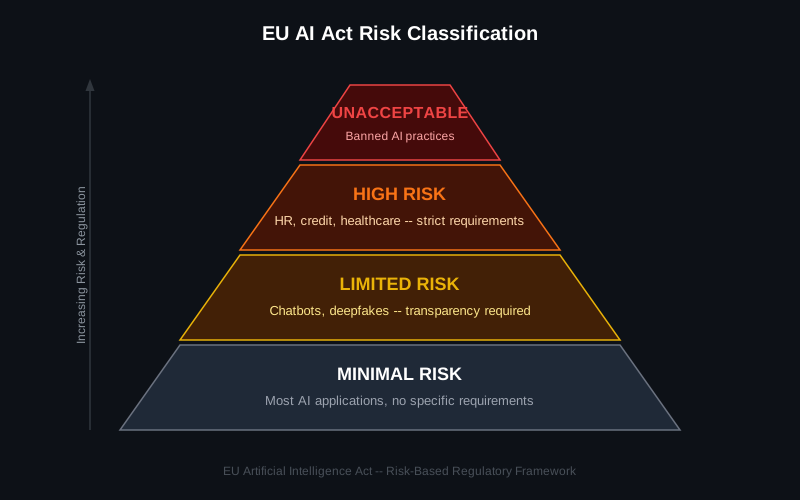
Unacceptable Risk (Prohibited)
Certain AI applications are banned outright. These include social scoring systems, real-time biometric identification in public spaces (with limited exceptions), AI that exploits vulnerabilities of specific groups, and AI that manipulates human behavior to cause harm. If your organization uses any of these applications, you must discontinue them.
High Risk
AI systems in critical areas carry the heaviest compliance burden. High-risk categories include AI used in employment and worker management, credit scoring and financial services, educational assessments, law enforcement, migration and border control, and critical infrastructure management.
High-risk AI systems require comprehensive documentation, risk management systems, data governance measures, transparency obligations, human oversight mechanisms, and conformity assessments.
Limited Risk
AI systems with limited risk, such as chatbots and AI-generated content, primarily face transparency obligations. Users must be informed when they are interacting with an AI system, and AI-generated content must be clearly labeled.
Minimal Risk
Most AI applications fall into this category and face no specific regulatory requirements under the Act, though general best practices still apply. Examples include spam filters, AI-powered recommendations, and inventory management systems.
Key Compliance Requirements
Risk Management System
For high-risk AI, you must establish a risk management system that identifies, analyzes, and mitigates risks throughout the AI system lifecycle. This system must be documented, regularly updated, and include provisions for testing and validation. Integrate this with your broader AI risk management framework.
Data Governance
Training, validation, and testing datasets must meet quality criteria. You must implement data governance practices that address completeness, accuracy, and representativeness. Bias detection and mitigation measures are required throughout the data pipeline.
Technical Documentation
Maintain comprehensive technical documentation that covers system design, development methodology, data handling, performance metrics, and risk mitigation measures. This documentation must be available for regulatory review.
Record Keeping
High-risk AI systems must automatically log events throughout their lifecycle. These audit trails must capture sufficient information to enable traceability of AI decisions and system performance.
Transparency and Information
Provide clear information to users about the AI system's capabilities, limitations, intended purpose, and level of accuracy. Deployers of high-risk AI systems must also provide meaningful information to affected individuals.
PolicyGuard helps companies like yours get AI governance documentation audit-ready in 48 hours or less.
Start free trial →Compliance Timeline
The Act's obligations phase in over time. Prohibited AI practices bans are already in effect. AI literacy requirements applied from February 2025. High-risk AI system requirements are coming into force throughout 2026. General-purpose AI model requirements also apply in 2026.
Practical Steps for Compliance
- Audit your AI portfolio: Identify all AI systems and classify them by risk level
- Gap analysis: Compare current practices against Act requirements for each risk level
- Prioritize high-risk systems: Focus compliance efforts on systems with the most stringent requirements
- Implement documentation: Create the required technical documentation and compliance framework
- Establish governance: Build or enhance your AI governance program
- Train your team: Ensure all relevant staff understand their obligations
How PolicyGuard Helps
PolicyGuard maps your AI governance program directly to EU AI Act requirements. Our platform tracks your compliance posture, manages required documentation, and provides audit-ready evidence. Start your free trial to assess your EU AI Act readiness.
Frequently Asked Questions
Does the EU AI Act apply to companies outside the EU?
Yes. The Act applies to any organization that places AI systems on the EU market or whose AI systems affect people in the EU, regardless of where the company is headquartered. This extraterritorial scope is similar to GDPR.
What are the penalties for non-compliance?
Fines range from 7.5 million euros or 1.5 percent of turnover for minor violations, up to 35 million euros or 7 percent of global turnover for prohibited AI practices. The specific fine depends on the severity and nature of the violation.
How does the Act interact with GDPR?
The EU AI Act complements GDPR rather than replacing it. AI systems that process personal data must comply with both regulations. Data governance requirements under the AI Act align with GDPR principles but add AI-specific requirements.
Do we need to classify every AI tool we use?
Yes. You should maintain an inventory of all AI systems in use and classify each by risk level. This classification drives your compliance obligations. Even minimal-risk systems should be documented for completeness.
What counts as a "high-risk" AI system?
The Act defines high-risk AI systems in Annex III, which covers areas like biometrics, critical infrastructure, education, employment, essential services, law enforcement, migration, and administration of justice. If your AI system makes or influences decisions in these areas, it is likely high-risk.