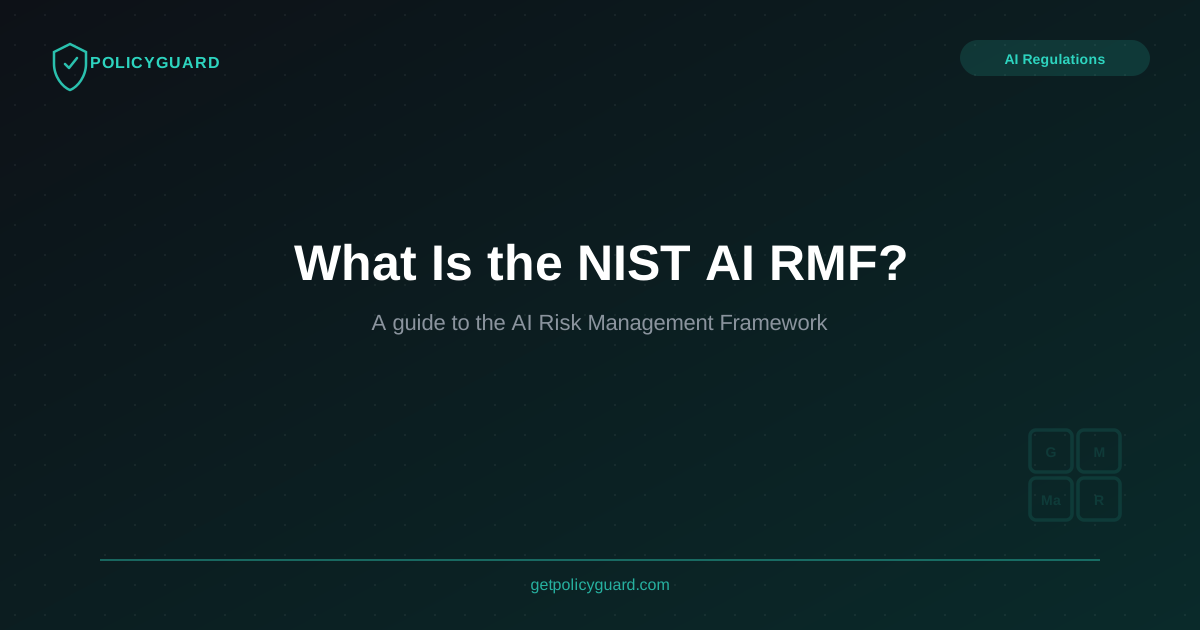
The NIST AI Risk Management Framework is a voluntary approach from the US National Institute of Standards and Technology that helps organizations manage AI risks through four core functions: Govern, Map, Measure, and Manage.
Released in January 2023 and updated with companion resources since, the NIST AI RMF provides a structured, flexible methodology for identifying, assessing, and mitigating AI-related risks. It is not a regulation but increasingly serves as the baseline that regulators and auditors reference.
TL;DR: NIST AI RMF is the US government's voluntary blueprint for managing AI risk, built around four functions.
NIST AI RMF: A voluntary framework from NIST providing a structured approach to managing AI-related risks.
The NIST AI Risk Management Framework gives organizations a common language and structure for AI risk management. Unlike prescriptive regulations, it is designed to be adapted to any organization's size, sector, and AI maturity level. Here is what each function covers, whether it is mandatory for your organization, and how it compares to other major AI governance frameworks.
Four Functions Explained
The framework is organized into four core functions. Each contains categories and subcategories that define specific activities.
| Function | Covers | Key Activities | Who Is Responsible |
|---|---|---|---|
| Govern | Organizational culture, policies, accountability structures | Establish AI governance policies, define roles, allocate resources, set risk tolerance | Executive leadership, legal, compliance |
| Map | Context and risk identification | Identify AI systems in use, catalog intended purposes, map stakeholders, assess potential impacts | AI teams, product owners, risk managers |
| Measure | Risk analysis and assessment | Quantify identified risks, test AI systems, evaluate bias, track metrics over time | Data science, QA, risk analysts |
| Manage | Risk treatment and monitoring | Prioritize risks, implement mitigations, monitor for emerging risks, document decisions | Engineering, operations, compliance |
The Govern function is cross-cutting. It applies to and informs all other functions. Organizations that skip Govern and jump directly to Map-Measure-Manage typically lack the accountability structures needed to sustain risk management over time.
Is It Mandatory?
The NIST AI RMF is voluntary, but the practical reality is more nuanced than a simple yes or no.
- Mandatory: Federal agencies are required to use the AI RMF under Executive Order 14110 (October 2023) and subsequent OMB guidance. Federal contractors working on AI systems must also demonstrate alignment.
- Expected: Organizations in regulated industries (financial services, healthcare, critical infrastructure) will increasingly face auditors and regulators who use the NIST AI RMF as a benchmark. Not following it is not a violation, but deviating without an alternative framework raises questions.
- Optional but advantageous: Private organizations with no regulatory mandate benefit from adopting the framework because it provides a defensible, recognized structure. If an AI incident occurs, demonstrating NIST alignment shows due diligence.
The trend is clear: voluntary today often becomes expected tomorrow. Organizations that adopt the framework early avoid scrambling when it becomes a de facto requirement in their sector.
NIST AI RMF vs EU AI Act vs ISO 42001
Three major frameworks dominate AI governance. They overlap but serve different purposes.
| Dimension | NIST AI RMF | EU AI Act | ISO 42001 |
|---|---|---|---|
| Type | Voluntary framework | Binding regulation | Certifiable standard |
| Geography | US-focused, globally referenced | EU, extraterritorial reach | International |
| Enforcement | None (voluntary) | Fines up to 7% global revenue | Certification audit |
| Structure | 4 functions, flexible | Risk-based classification tiers | Management system (Plan-Do-Check-Act) |
| Best for | Risk-based internal governance | Legal compliance for EU markets | Third-party certification |
| Cost to implement | Low to moderate | High (especially for high-risk systems) | Moderate to high |
These frameworks are complementary, not competing. An organization can use the NIST AI RMF as its internal risk management methodology, certify to ISO 42001 for external credibility, and map controls to EU AI Act requirements for regulatory compliance. The key is starting with one framework and mapping to others rather than attempting all three simultaneously.
Align to NIST AI RMF Faster
PolicyGuard maps your AI governance activities to NIST AI RMF functions automatically. See gaps, track progress, and generate compliance evidence.
Start free trialPolicyGuard helps companies like yours get AI governance documentation audit-ready in 48 hours or less.
Start free trial →Who Should Use It
Four types of organizations benefit most from adopting the NIST AI RMF.
- Federal agencies and contractors: Required under executive order. The framework is the expected standard for AI risk management across the federal government and its supply chain.
- Regulated industries (finance, healthcare, energy): Industry regulators increasingly reference NIST standards. Adopting the AI RMF aligns AI governance with existing NIST-based compliance programs like the NIST Cybersecurity Framework.
- Organizations pursuing ISO 42001 certification: The NIST AI RMF provides a practical methodology for implementing ISO 42001 requirements. The two frameworks map well to each other, and many organizations use NIST as the operational layer beneath ISO certification.
- Companies deploying AI at scale: Any organization with more than a handful of AI tools benefits from a structured risk management approach. The framework scales from a simple initial assessment to a comprehensive ongoing program.
For practical guidance on implementing the framework, see our NIST AI RMF implementation guide. For a broader view of AI risk management approaches, read our AI risk management framework overview.
Frequently Asked Questions
Is the NIST AI RMF the same as the NIST Cybersecurity Framework?
No. They are separate frameworks addressing different risk domains. The AI RMF focuses on AI-specific risks like bias, transparency, and accountability. The Cybersecurity Framework focuses on protecting systems and data. However, they share design principles and can be used together within an integrated risk management program.
How long does it take to implement the NIST AI RMF?
An initial assessment and gap analysis takes 2-4 weeks. Implementing core governance structures takes 2-3 months. Full maturity across all four functions typically takes 6-12 months depending on organizational size and AI complexity.
Does NIST AI RMF apply to organizations outside the US?
The framework is US-originated but designed for global applicability. Non-US organizations increasingly adopt it because it provides a well-structured methodology that complements local regulations. It is particularly useful as a foundation before mapping to jurisdiction-specific requirements.
Can startups use the NIST AI RMF?
Yes. The framework is designed to scale. Startups can begin with the Govern function to establish basic accountability and policies, then expand to Map, Measure, and Manage as their AI usage grows. A lightweight implementation takes weeks, not months.
How does NIST AI RMF handle generative AI specifically?
NIST released a companion document, the Generative AI Profile (NIST AI 600-1), which maps generative AI-specific risks to the AI RMF framework. It addresses risks like hallucination, data provenance, intellectual property, and content safety within the existing four-function structure.
NIST AI RMF Compliance Made Practical
PolicyGuard maps your AI governance program to all four NIST AI RMF functions. Identify gaps, implement controls, and generate evidence auditors expect.
Start free trial