The NIST AI Risk Management Framework (NIST AI RMF) is a voluntary framework published by the National Institute of Standards and Technology that helps organizations manage risks associated with AI systems.
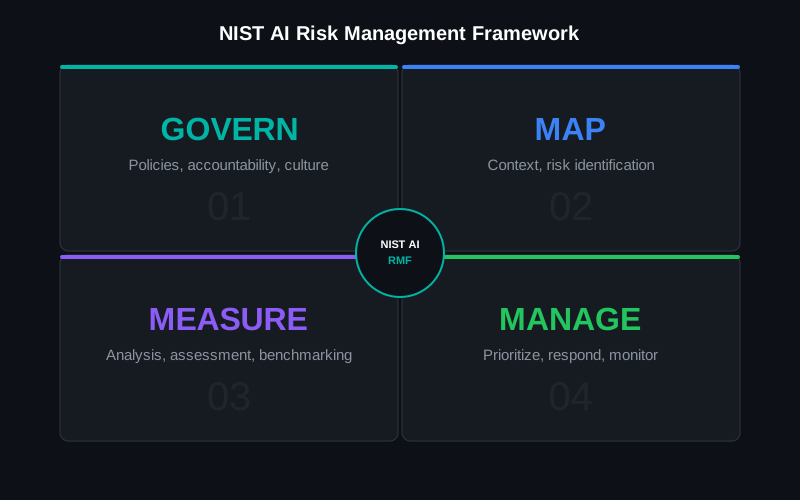
It is organized into four core functions: Govern, Map, Measure, and Manage. While voluntary for private sector organizations, it is increasingly treated as the standard of care by regulators and is referenced in federal procurement requirements.
Understanding the NIST AI RMF
The NIST AI Risk Management Framework provides a structured, voluntary approach to managing AI risks throughout the AI system lifecycle. Unlike prescriptive regulations, the NIST AI RMF is designed to be adaptable to organizations of all sizes and across all sectors. It has become the de facto standard for AI risk management in the United States and is increasingly referenced internationally.
The framework is organized around four core functions: Govern, Map, Measure, and Manage. Each function contains categories and subcategories that guide implementation. This guide provides practical steps for implementing each function.
Function 1: Govern
The Govern function establishes the organizational context for AI risk management. It is foundational and cross-cutting, informing how the other three functions are performed.
Key Activities
- Establish AI governance policies and processes
- Define roles and responsibilities for AI risk management
- Align AI risk management with organizational risk tolerance
- Create accountability structures for AI outcomes
- Establish a culture of responsible AI use
Practical Steps
Start by documenting your organization's AI principles and risk tolerance. Create an AI governance committee with representation from technical, legal, business, and ethics perspectives. Develop and deploy employee policies that translate governance principles into actionable requirements.
Function 2: Map
The Map function focuses on understanding the context in which AI systems operate. It establishes awareness of risks by identifying what AI systems you have, how they are used, and who they affect.
Key Activities
- Inventory all AI systems and their purposes
- Identify stakeholders affected by AI systems
- Understand the intended and potential unintended uses
- Assess the operational environment and constraints
- Identify potential sources of bias and harm
Practical Steps
Conduct a comprehensive AI inventory that includes both official and shadow AI tools. For each system, document the use case, data inputs, decision outputs, affected populations, and responsible teams. Create system cards that summarize this information in a standardized format.
PolicyGuard helps companies like yours get AI governance documentation audit-ready in 48 hours or less.
Start free trial →Function 3: Measure
The Measure function employs quantitative, qualitative, or mixed-method tools to analyze, assess, benchmark, and monitor AI risk and related impacts.
Key Activities
- Assess AI system performance against requirements
- Test for bias, fairness, and accuracy
- Monitor for drift and degradation over time
- Evaluate security and privacy protections
- Measure compliance with policies and regulations
Practical Steps
Define metrics for each AI system based on its risk level and use case. Implement automated monitoring where possible and establish regular review cycles. Use your audit trail to capture measurement data and create dashboards that visualize AI risk trends over time.
Function 4: Manage
The Manage function allocates risk resources based on assessments. It plans, implements, and monitors risk treatment actions.
Key Activities
- Prioritize risks for treatment based on assessment results
- Implement risk mitigation controls
- Establish incident response procedures
- Communicate risk information to stakeholders
- Review and update risk treatments regularly
Practical Steps
Create a risk treatment plan for each high-priority risk identified through the Measure function. Assign owners, define timelines, and track progress. Build on your risk management framework to ensure consistency across AI systems.
Integration with Other Frameworks
The NIST AI RMF is designed to complement other frameworks. Map its requirements to the EU AI Act, ISO 42001, and your compliance framework to create unified controls that satisfy multiple requirements simultaneously.
How PolicyGuard Helps
PolicyGuard maps directly to NIST AI RMF requirements, providing policy templates, risk assessment tools, and compliance tracking aligned with the framework. Start your free trial to accelerate your NIST AI RMF implementation.
Frequently Asked Questions
Is the NIST AI RMF mandatory?
The framework is voluntary for the private sector but is increasingly expected as a standard of care. Federal agencies and their contractors may face mandatory adoption requirements. Many organizations adopt it proactively because it demonstrates responsible AI management.
How does the NIST AI RMF relate to the EU AI Act?
While structurally different, the two frameworks share common objectives. NIST AI RMF implementation can support EU AI Act compliance, particularly in the areas of risk management, documentation, and monitoring. Organizations subject to both can use the NIST framework as a foundation and add EU AI Act-specific requirements.
Can small organizations implement the NIST AI RMF?
Yes. The framework is designed to be scalable. Small organizations can implement core elements of each function proportional to their AI usage and risk. Start with Govern and Map, which require minimal technical resources, then build out Measure and Manage as your AI program grows.
How long does full implementation take?
A basic implementation covering all four functions can be achieved in three to six months. Reaching maturity with comprehensive measurement and management capabilities typically requires twelve to eighteen months, depending on the complexity of your AI landscape.
What resources does NIST provide?
NIST provides the core framework document, companion playbook with suggested actions, crosswalks to other standards, and AI RMF profiles for specific use cases. All materials are freely available on the NIST website.