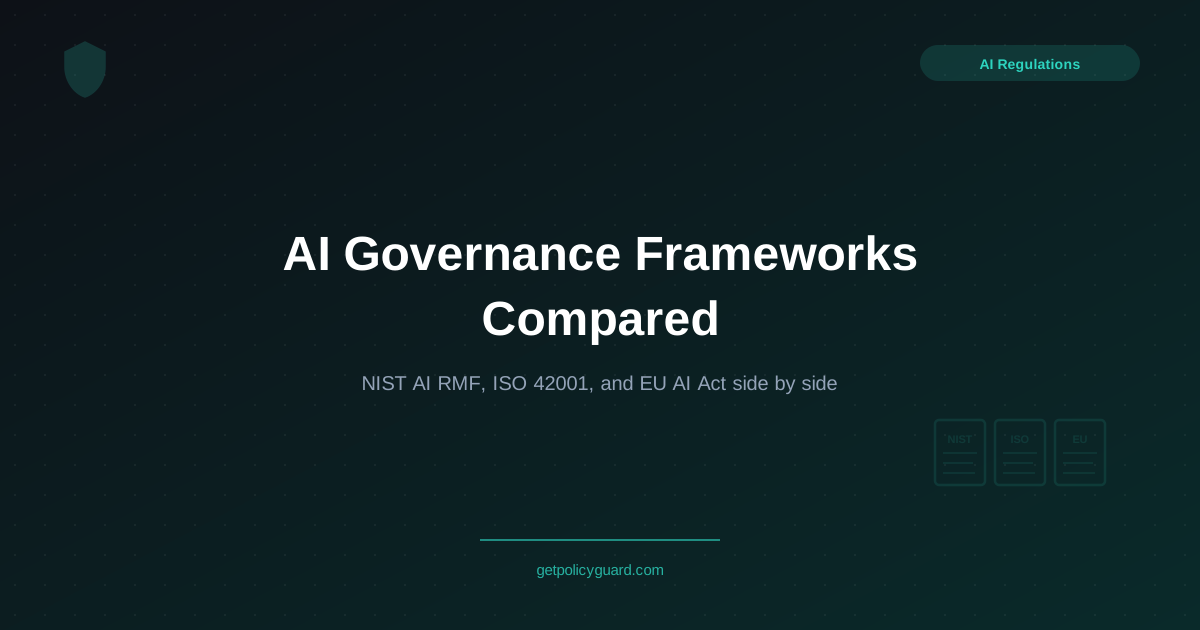
The three primary frameworks are NIST AI RMF (voluntary, US-focused), ISO 42001 (international, certifiable), and EU AI Act (mandatory for EU-connected orgs). They are complementary rather than competing.
Organizations building AI governance programs face a landscape of overlapping frameworks. NIST AI RMF provides a flexible, voluntary risk management structure widely adopted in the United States. ISO 42001 offers an internationally recognized, certifiable management system for AI. The EU AI Act imposes mandatory, legally binding requirements on any organization that places AI systems on the EU market or affects EU residents. Most organizations will need to engage with more than one.
Choosing an AI governance framework is not a simple either-or decision. Each framework serves a different purpose, carries different weight with regulators, and demands different levels of investment. Some organizations need certification to win enterprise deals. Others face mandatory compliance deadlines with financial penalties. Still others want a structured approach to AI risk without external mandates. This comparison breaks down the three dominant frameworks so you can make an informed decision about which to adopt, and in what order.
What Is NIST AI RMF?
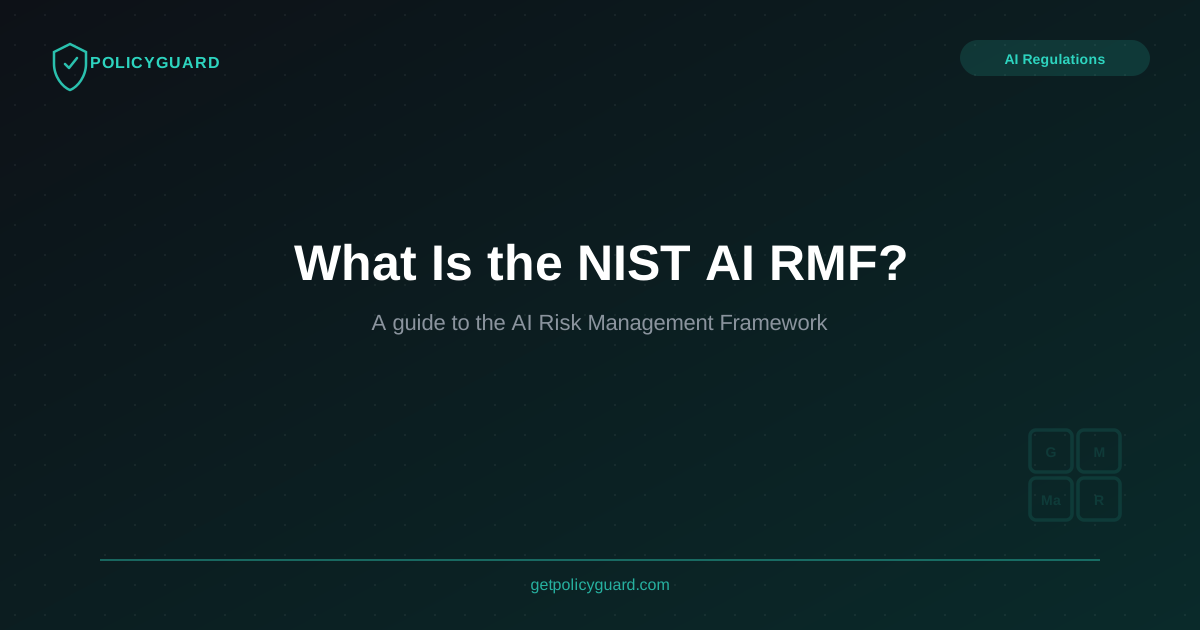
The NIST AI Risk Management Framework (AI RMF) is a voluntary framework published by the U.S. National Institute of Standards and Technology. Released in January 2023, it provides a structured approach to identifying, assessing, and mitigating risks associated with AI systems throughout their lifecycle.
NIST AI RMF is organized around four core functions: Govern, Map, Measure, and Manage. The Govern function establishes organizational AI risk management policies and processes. Map identifies the context and risks associated with specific AI systems. Measure evaluates and tracks identified risks using quantitative and qualitative methods. Manage implements controls and mitigations to address those risks.
The framework is deliberately flexible. It does not prescribe specific controls or technologies. Organizations choose which elements to implement based on their risk profile, industry, and maturity. This flexibility is both its strength and its limitation: it provides guidance without guaranteeing compliance with any specific regulation. For a detailed walkthrough, see our NIST AI RMF implementation guide.
What Is ISO 42001?
ISO/IEC 42001 is an international standard published by the International Organization for Standardization that specifies requirements for an AI management system (AIMS). It is the first international certifiable standard dedicated to AI governance.
ISO 42001 follows the familiar Annex SL management system structure used in ISO 27001, ISO 9001, and other management system standards. This means organizations already certified to ISO 27001 will recognize the structure: context analysis, leadership commitment, planning, support, operation, performance evaluation, and improvement. The AI-specific additions include requirements for AI risk assessments, AI impact assessments, data governance for AI systems, and transparency and explainability documentation.
The key differentiator is certification. Organizations can undergo a third-party audit and receive ISO 42001 certification, providing an externally validated signal that their AI governance meets international standards. This certification is increasingly requested in enterprise procurement and regulatory contexts. See our guide on ISO 42001 and agentic AI governance for implementation details.
What Is the EU AI Act?
The EU AI Act is a legally binding regulation adopted by the European Union that establishes mandatory requirements for AI systems based on their risk classification. It applies to any organization that develops, deploys, or distributes AI systems within the EU market, regardless of where the organization is headquartered.
The Act classifies AI systems into four risk tiers: unacceptable risk (banned), high risk (heavy obligations), limited risk (transparency obligations), and minimal risk (no specific requirements). High-risk systems, which include AI used in employment, education, critical infrastructure, and law enforcement, face the most extensive requirements: conformity assessments, technical documentation, human oversight, accuracy and robustness testing, and post-market monitoring.
Unlike NIST and ISO 42001, the EU AI Act carries legal penalties. Non-compliance can result in fines of up to 35 million euros or 7% of global annual turnover, whichever is higher. Compliance deadlines are phased: provisions on banned AI practices took effect in February 2025, with high-risk system requirements following in August 2026. For detailed requirements, see our EU AI Act compliance guide.
PolicyGuard helps companies like yours get AI governance documentation audit-ready in 48 hours or less.
Start free trial →Side-by-Side Comparison
The following table compares NIST AI RMF, ISO 42001, and the EU AI Act across the dimensions that determine which framework to prioritize.
| Dimension | NIST AI RMF | ISO 42001 | EU AI Act |
|---|---|---|---|
| Mandatory or voluntary | Voluntary. No legal requirement to adopt, though referenced by some U.S. federal agencies in procurement and some state-level AI legislation cites it as a best practice baseline. | Voluntary. Adoption is a business decision, though increasingly required by enterprise customers and referenced in procurement RFPs as a governance signal. | Mandatory for any organization that places AI systems on the EU market or whose AI systems affect EU residents. Legal obligation, not a best practice. |
| Geographic scope | Primarily United States. Developed by a U.S. agency, most commonly adopted by U.S. organizations, U.S. federal contractors, and companies operating primarily in the U.S. market. | International. Recognized globally. Particularly strong adoption in Europe, Asia-Pacific, and among multinational organizations that need a framework accepted across jurisdictions. | European Union with extraterritorial reach. Applies to non-EU organizations if their AI systems are placed on the EU market or affect EU residents. Similar extraterritorial scope as GDPR. |
| Certification available | No formal certification program. Organizations can self-attest to alignment or engage consultants to assess maturity, but there is no accredited third-party certification body for NIST AI RMF compliance. | Yes. Accredited certification bodies conduct formal audits and issue ISO 42001 certificates. Certification provides externally validated evidence of AI governance maturity that auditors and customers recognize. | Not certification in the ISO sense, but high-risk systems require conformity assessments. Some assessments can be self-conducted; others require notified bodies depending on the AI system category. |
| Risk-based approach | Yes. The entire framework is organized around risk identification, measurement, and management. Organizations choose which risks to prioritize based on their context. Highly flexible but requires mature risk judgment. | Yes. Requires formal AI risk assessments and AI impact assessments. Risk-based but within a structured management system that prescribes documentation and review processes. | Yes. The Act is fundamentally risk-based, with obligations escalating by risk tier. However, the risk classification is defined by the regulation, not by the organization. Less flexibility in how risks are categorized. |
| Cost to implement | Low to moderate. No certification fees. Primary costs are staff time for risk assessment documentation, policy development, and process implementation. Organizations can adopt incrementally. Typical range: $20K-$100K for initial implementation depending on scope. | Moderate to high. Certification audit fees range from $15K to $50K depending on organization size. Implementation consulting typically adds $50K to $200K. Ongoing surveillance audits add annual costs. Total first-year cost: $75K-$300K for mid-size organizations. | High. Conformity assessments, technical documentation, post-market monitoring systems, and legal review create significant compliance costs. Estimates range from $100K to $500K+ for high-risk systems. Penalties for non-compliance add financial risk: up to 35M euros or 7% of global turnover. |
| Regulatory recognition | Recognized by U.S. federal agencies. Referenced in Executive Orders on AI safety. Increasingly cited in state-level AI legislation. Provides a defensible basis for AI governance in U.S. regulatory contexts. | Recognized internationally. Provides the strongest governance signal in enterprise procurement. Increasingly referenced by regulators as evidence of AI governance maturity. Aligns with EU AI Act requirements though not a substitute for compliance. | The regulation itself. Compliance is not optional for organizations in scope. Recognized globally as the most comprehensive mandatory AI regulation. Sets the de facto global standard that other jurisdictions reference. |
| Best suited for | U.S.-based organizations seeking a flexible AI risk management approach. Federal contractors and suppliers. Organizations at early AI governance maturity that want a structured starting point without certification overhead. | Multinational organizations that need internationally recognized AI governance certification. Companies in regulated industries where customers or partners require demonstrable AI governance. Organizations already familiar with ISO management system standards. | Any organization deploying AI systems that affect EU residents or are placed on the EU market. Organizations in high-risk AI sectors: healthcare, employment, education, financial services, law enforcement. Companies that need to demonstrate legal compliance rather than voluntary best practice. |
When NIST AI RMF Makes Sense
NIST AI RMF is the right starting point in several scenarios.
- You are a U.S.-based organization without EU market exposure. If your AI systems do not affect EU residents and you do not need international certification, NIST AI RMF provides a comprehensive risk management approach without the cost and overhead of ISO certification or EU compliance.
- You are a federal contractor or supplier. U.S. government agencies increasingly reference NIST AI RMF in procurement requirements. Alignment with the framework positions you for federal contracts and demonstrates governance maturity to government buyers.
- You want a flexible starting framework. NIST AI RMF allows incremental adoption. You can start with the Govern function, establish policies, and expand to Map, Measure, and Manage as your AI governance program matures. No external audit timeline forces your pace.
- You plan to pursue ISO 42001 later. NIST AI RMF and ISO 42001 share significant conceptual overlap. Starting with NIST builds the foundation for a future ISO certification with less rework than starting from scratch.
When ISO 42001 Makes Sense
ISO 42001 becomes the priority when external validation matters.
- Enterprise customers require governance proof. When procurement teams ask "how do you govern your AI?" a certificate carries more weight than a self-assessment. ISO 42001 certification answers that question definitively.
- You operate across multiple jurisdictions. ISO standards are recognized globally. A single ISO 42001 certification provides governance credibility in the U.S., EU, Asia-Pacific, and other markets simultaneously without jurisdiction-specific frameworks.
- You are already ISO 27001 certified. The management system structure is nearly identical. Your existing ISMS processes, internal audit capabilities, and management review cycles transfer directly. The incremental effort is substantially lower than a greenfield implementation.
- You want to get ahead of regulatory requirements. ISO 42001 alignment satisfies many of the organizational and documentation requirements that regulations like the EU AI Act mandate. Certification now positions you for smoother regulatory compliance later.
When the EU AI Act Takes Priority
The EU AI Act is not optional for organizations in scope. It becomes the immediate priority in these situations.
- You deploy AI systems on the EU market. If your AI tools, products, or services are available to EU customers or users, you are in scope regardless of where your organization is headquartered. Compliance is a legal obligation, not a governance choice.
- Your AI systems affect EU residents. Even if you do not market directly in the EU, AI systems that process data about EU residents or make decisions affecting them trigger the Act's extraterritorial provisions.
- You operate in a high-risk AI category. AI used in employment decisions, educational assessments, credit scoring, healthcare diagnostics, or law enforcement faces the Act's most stringent requirements. Conformity assessments, technical documentation, and human oversight are mandatory.
- Compliance deadlines are approaching. With banned practices already in effect and high-risk system requirements landing in August 2026, organizations in scope cannot wait. Implementation timelines of 6 to 12 months mean work must begin now.
Not sure which framework to start with? Talk to PolicyGuard and get a framework assessment based on your organization's specific regulatory exposure, industry, and AI maturity.
How PolicyGuard Fits
PolicyGuard is framework-agnostic by design. The platform generates the operational evidence that all three frameworks require: AI tool inventories, usage logs, policy enforcement records, training completions, and risk assessment documentation. Whether you are aligning to NIST AI RMF, pursuing ISO 42001 certification, or preparing for EU AI Act compliance, PolicyGuard produces audit-ready evidence mapped to each framework's specific control requirements.
Organizations pursuing multiple frameworks simultaneously benefit most. PolicyGuard collects the data once and maps it to NIST functions, ISO 42001 clauses, and EU AI Act obligations in parallel. This eliminates the duplication that occurs when separate teams build separate evidence packages for each framework. See our guides on NIST AI RMF implementation, ISO 42001 governance, and EU AI Act compliance for framework-specific details.
FAQ
Can I comply with all three frameworks simultaneously?
Yes, and most multinational organizations should. The frameworks are complementary. NIST AI RMF provides the risk management methodology, ISO 42001 provides the certifiable management system, and the EU AI Act defines the mandatory legal requirements. Approximately 70% of the documentation and operational requirements overlap. The key is building a unified evidence collection system that maps to all three frameworks rather than running parallel compliance programs.
Which framework should I start with if I have limited resources?
Start with whatever carries immediate consequences. If you are in scope for the EU AI Act, that takes priority because non-compliance carries fines. If you need certification to close enterprise deals, start with ISO 42001. If neither applies, NIST AI RMF is the lowest-cost starting point that builds toward the other two. Regardless of which framework you start with, the operational work is similar: inventory your AI tools, define policies, implement monitoring, and generate audit evidence.
Does ISO 42001 certification satisfy EU AI Act requirements?
Not directly, but it helps significantly. ISO 42001 certification demonstrates that you have an AI management system with risk assessments, documentation, and oversight processes. The EU AI Act requires these plus specific technical requirements like conformity assessments for high-risk systems, post-market monitoring, and incident reporting. ISO 42001 provides the organizational foundation; the EU AI Act adds technical and legal layers on top. Expect 60-70% overlap in the documentation required.
How often do these frameworks change?
NIST AI RMF is updated periodically as AI risks evolve. NIST published the companion Generative AI Profile in 2024 and may release additional profiles. ISO 42001 follows the standard ISO revision cycle, typically every 5 years, with the first revision expected around 2028-2029. The EU AI Act provisions roll out in phases through 2027, with delegated acts and guidance documents published on an ongoing basis. All three are living frameworks that will evolve as AI technology and risks change.
What if my industry has its own AI regulations in addition to these frameworks?
Sector-specific regulations in healthcare (FDA AI guidance), financial services (OCC, Fed guidance on model risk), and other industries layer on top of these horizontal frameworks. The good news is that sector-specific requirements generally align with the risk management principles in NIST, ISO 42001, and the EU AI Act. A robust AI governance program built on these frameworks covers 80-90% of sector-specific requirements. The gaps are usually in domain-specific documentation, validation testing, and reporting obligations.
Map your framework obligations in one place. Schedule a PolicyGuard demo to see how one platform generates evidence for NIST, ISO 42001, and the EU AI Act simultaneously.